
How Air Duct Cleaning Quotes Work in Reno
From the quote form to a visibly clean system: how getting quotes works, what a proper source-removal cleaning involves, and how to check the job afterward.
Get a Free QuoteGetting quotes, step by step
We connect Reno-area homeowners with independent local duct cleaning and HVAC companies for free, no-obligation quotes. Here is what happens after you ask.
Tell us about your home
Fill out the short quote form with your name, phone, ZIP and the service you need. Mention your home size, roughly how many vents you have, where the furnace sits (attic, garage, closet or crawlspace) and what prompted the request, such as dust from the registers, a smoke odor or pests.
A local company follows up
We pass your request to an independent duct cleaning or HVAC company that works your part of the Reno area. We usually reply the same day. We don't do the work ourselves; the company that contacts you quotes and performs the job.
Get a written quote and see the problem
EPA suggests asking the company to show you the contamination that justifies cleaning, and to provide a written agreement with the total cost and full scope before work begins. Ask what parts of the system are included: ducts, registers, coils, blower and air handler.
Check the license and compare
Look up the company on the Nevada State Contractors Board license search. Confirm the license is active and that the name matches. EPA recommends talking to at least three providers, so compare scope as well as price before you decide.
Check the work afterward
After the cleaning, look at the registers and, where you can, inside the ducts and air handler. EPA says all portions of the system should be visibly clean, and NADCA says a system should not be considered cleaned if dust or debris can be seen.
Nevada requires contractors to show their license number in their ads; check any company on the NSCB license search before you hire. See how to check a Nevada contractor license.
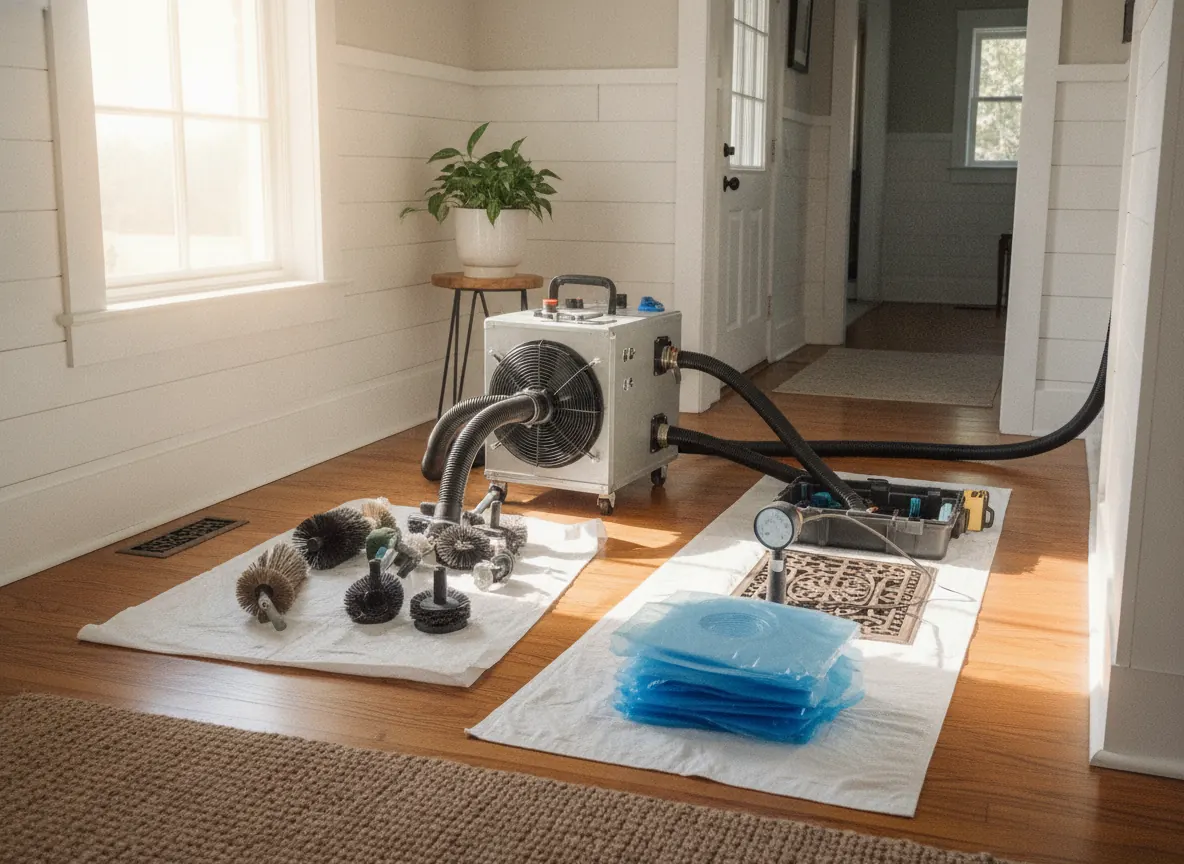
What a NADCA-style source-removal cleaning involves
NADCA, the National Air Duct Cleaners Association, calls source removal "the most effective way to clean air ducts and ventilation systems." In its words, this "requires a contractor to place the system under negative pressure, through the use of a specialized, powerful vacuum. While the vacuum draws air through the system, devices are inserted into the ducts to dislodge any debris that might be stuck to interior surfaces. The debris can then travel down the ducts to the vacuum, which removes it from the system and the home."
Two points from NADCA's consumer FAQ are worth knowing before a crew arrives:
- "Any vacuum collection device which exhausts indoors must be HEPA filtered."
- "A vacuum collection device alone will not get an HVAC system clean." Agitation tools such as brushes, air whips and "skipper balls" are needed to loosen debris.
NADCA's process page adds that "the entire HVAC system is placed under continuous negative pressure" during cleaning "to prevent the spread of contaminants."
What EPA says a provider should do
EPA's guide "Should You Have the Air Ducts in Your Home Cleaned?" lists what a duct cleaning service provider should do. Use it as a checklist when you compare quotes:
- Inspect the system for asbestos-containing materials before cleaning.
- "Open access ports or doors to allow the entire system to be cleaned and inspected."
- "Use vacuum equipment that exhausts particles outside of the home or use only high-efficiency particle air (HEPA) vacuuming equipment if the vacuum exhausts inside the home."
- "Use well-controlled brushing of duct surfaces in conjunction with contact vacuum cleaning."
- "Use only soft-bristled brushes for fiberglass duct board."
- Seal and re-insulate any access holes made during cleaning.
- "Follow NADCA's standards for air duct cleaning and NAIMA's recommended practice."
EPA also warns that "an inadequate vacuum collection system can release more dust, dirt and other contaminants than if you had left the ducts alone." The full scope covers supply and return ducts, registers, grilles and diffusers, heating and cooling coils, drain pans, the fan motor and housing, and the air handler. EPA notes that skipping a contaminated component "can result in re-contamination of the entire system." For more detail, read NADCA source removal explained.
Sanitizers and sealants: ask before you agree
Some companies offer to spray a sanitizer or biocide after cleaning. Whether to ask about it is your choice. EPA says "research has not demonstrated their effectiveness in duct cleaning or their potential adverse health effects," and "no chemical biocides are currently registered by EPA for use in internally-insulated air duct systems." If you permit one, EPA says the provider should show you the biocide label and apply it only to uninsulated areas after proper cleaning. EPA also says NADCA, NAIMA and SMACNA do not currently recommend routine use of sealants to coat the inside of ducts. That is different from sealing duct air leaks, which EPA says can help save energy.
EPA's post-cleaning checklist
When the crew finishes, walk through the job before you pay:
- All portions of the system should be visibly clean. EPA: "you should not be able to detect any debris with the naked eye."
- Check the registers, the blower compartment and, where you can see in, the duct interiors.
- Make sure any access holes are sealed and insulation is restored.
- Confirm the work matches the written agreement, and that any biocide used was applied only as its label directs.
- If you see dust or debris, say so. NADCA: "If any dust or debris can be seen during the visual inspection, the system should not be considered cleaned."
Ready to compare prices? See the air duct cleaning cost guide or the FAQ, then request a free quote.
Dusty vents or smoke smell? Compare duct cleaning quotes.
Free, no-pressure quotes across Reno, Sparks, Spanish Springs and the Truckee Meadows.